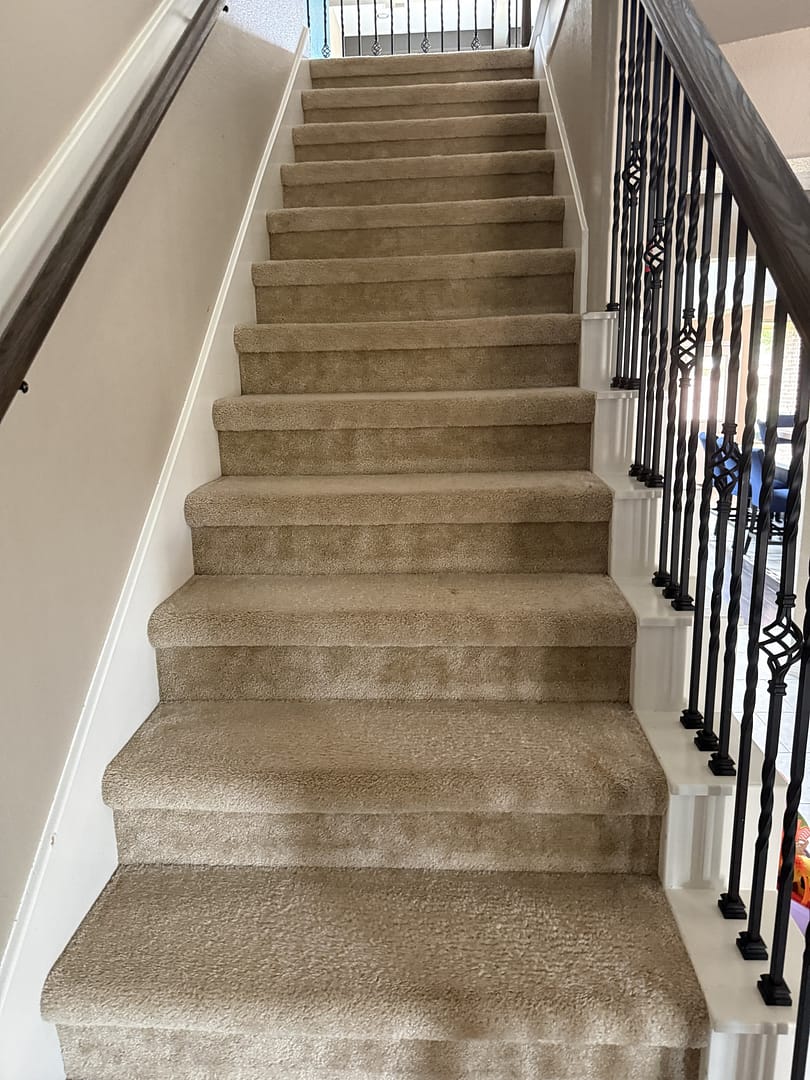
How to clean different types of floors: a dry pass first on every floor, then the cleaner that floor’s maker allows: a barely damp mop for hardwood, a laminate cleaner on a damp microfiber only if the maker allows one, a rinsed alkaline or neutral cleaner for ceramic tile, and slow overlapping vacuum passes for carpet and rugs.
In the homes we clean, three of the four under one roof is common, and the mistakes we see are rarely about effort. They’re about the same bucket and the same bottle going from the tile to the wood to the laminate, and about the vacuum moving too fast to pick up what it’s rolling over.
This post is the honest version by floor type, then the local part (humidity, sand, hard water), then where the line sits between what you do and what a cleaning visit does, and what no cleaning can fix.
Key Takeaways
| Question | Short answer |
|---|---|
| How to clean different types of floors in one rule? | Dry pass first on all of them (dust mop, broom or vacuum), then the cleaner the floor’s maker allows, one product at a time, and let it dry. |
| Hardwood? | A barely damp mop with a cleaner made for wood floors. No wet mop, no steam mop, no vinegar, bleach or ammonia. The humidity side is in hardwood floors and humidity. |
| Tile and grout? | Sweep, then a mild alkaline or pH-neutral cleaner, then rinse with clean water. Acids eat cement grout; oil and wax soaps leave a film that collects dirt. |
| Laminate? | Dry sweep or vacuum is the routine; a laminate cleaner on a damp microfiber only if your floor’s maker allows one, dried behind you. No wet mop, no soap and water, no steam. |
| Carpet and rugs? | Slow, overlapping passes to the edges, weekly, daily in the busy spots. The method is in how to vacuum carpet; steam cleaning is a separate, separately booked job. |

How to Clean Different Types of Floors: One Order, Four Cleaners
The order is the same on every floor in the house; only the product and how wet it gets change. Dry first, because grit under a mop is sandpaper. Spot-treat anything stuck with a product the floor’s maker allows. Then the damp pass with the product the floor’s maker allows, and then let the floor dry before the family walks on it.
Before you start: name the floor
The product rules below depend on knowing what the floor is, and wood-look plank can be laminate or vinyl as easily as wood. Three things to settle before anything comes out of the closet:
- Which floor is it? Solid or engineered hardwood (real wood, a finish on top) · laminate (a printed layer over a fiberboard core that swells when water gets in) · tile (ceramic or porcelain, with cement grout between) · natural stone tile (travertine, marble, slate, and its own rules: pH-neutral only). Vinyl plank (LVP) isn’t one of the four here; its maker’s care sheet is the method, and the laminate rules below (dry first, damp never wet, no abrasives, no steam unless the maker allows it) are the safe default until you’ve read it. If you don’t know what you have, the flooring maker’s care sheet or a flooring pro can tell you from a closet corner.
- One cleaner per floor, never mixed. Keep the wood cleaner, the laminate cleaner and the tile cleaner in separate bottles, and never pour one product into another or use two on one surface.
- Test in a closet. Any new product goes on a hidden square first; if the finish dulls or the grout darkens, the product is wrong for that floor.
The Four Floors, One at a Time
Hardwood: damp, never wet
Hardwood takes a dust mop or a vacuum on the bare-floor setting for the dry pass, then a cleaner made for wood floors on a mop that’s barely damp. The National Wood Flooring Association’s own maintenance advice is to avoid “wet or steam mops, which the NWFA says will cause more damage over time,” and to use “a dry or slightly damp cloth to immediately wipe up anything you spill.” Nothing acidic (vinegar) and nothing harsh (bleach, ammonia) goes on a wood finish; the finish is what you’re cleaning, and it’s what keeps water out of the boards.
In Houston the water isn’t only in the bucket. The NWFA’s range for a wood floor is 30 to 50 percent humidity, and NOAA’s normals put Houston’s outdoor air at 75 percent on average, so the AC is doing part of the floor care whether you think of it that way or not. That whole subject, including what cupping and seasonal gaps mean, is its own post: hardwood floors and humidity.
Tile and grout: water is your friend, acid is not
Ceramic and porcelain tile tolerate more water than the other floors here, and the grout between the tiles is what you’re actually protecting. The Tile Council of North America’s grout-cleaning guidance says cement grout “is dissolved by acids” and that “it is better to clean grout with an alkaline cleaner”; it also says “do not clean with oil or wax based cleaners,” because they “leave a waxy or oily film in the grout,” and that even a good cleaner “if not properly rinsed, will leave a sticky soap film.” The TCNA’s own line on the tile itself is that it “can often be cleaned with water.”
So the tile method is: sweep or vacuum, a mild alkaline or pH-neutral cleaner on the mop, then a rinse with clean water and a dry floor. The rinse is the step people skip, and in the homes we clean a dull haze on kitchen tile is often cleaner that was never rinsed off (the TCNA’s “sticky soap film”), not dirt. If the grout is already dark, the fixing side is in how to clean grout without damaging it. If the tile is natural stone, the rules change to pH-neutral only, and the stone caveats in how to deep clean a bathroom apply to the floor too.

Laminate: the one that looks like wood and minds water more
Laminate is a printed wear layer over a fiberboard core, and the core is why it minds water more than the hardwood it imitates. Shaw’s laminate care guidance is blunt: “Do not wash or wet mop the floor with soap, water, oil-soap detergent or any other liquid cleaning product,” and “avoid using steel wool, abrasive cleaners, or strong ammoniated or chlorinated type cleaners.”
That’s one maker’s sheet; yours overrides it, and the safe reading of it is that dry cleaning is the routine: a dry sweep or a vacuum with a soft brush. A liquid laminate product comes out only if your floor’s maker allows one, sprayed lightly on the microfiber pad (never on the floor), with a dry cloth behind it so nothing sits in the seams.
A steam mop is the tool that comes up most, and it’s the wrong one here: heat and moisture into the seams is exactly what the core can’t take. Grit matters more on laminate than on wood, because a wear layer can’t be refinished; Shaw’s sheet names entry mats, and so do I.
Carpet and rugs: slow passes, then steam separately
The vacuum does more for carpet than any product does, if it moves slowly. The Carpet and Rug Institute’s page on vacuuming puts it as maintenance, not tidying: “regular vacuuming removes soil and dirt that can damage the carpet fiber and therefore reduce the useful life of the carpet,” and the CRI’s frequency is “daily in high-traffic or pet areas, twice weekly in medium-traffic areas, and weekly in light-traffic areas.” The six-step method, including the edges, the height setting and the rugs, is in how to vacuum carpet.
What vacuuming can’t do is lift a set-in stain or anything that has soaked into the padding, and that’s where steam cleaning comes in, as a separate job with its own carpet steam cleaning booking page, not part of a regular or deep visit. A pet accident is the exception that needs its own order (an enzyme cleaner first, never steam on urine), and that’s in how to get rid of pet odor.
Use and Avoid, by Floor
The riskiest decision in floor care isn’t the order; it’s what goes on which surface. One table, so it can be read before the bottle is opened:
| Floor | Use | Avoid |
|---|---|---|
| Hardwood (sealed) | A dust mop or bare-floor vacuum; a cleaner made for wood floors on a barely damp mop; spills wiped at once | A wet mop or steam mop; vinegar, bleach, ammonia; water left to sit; a beater bar on the floor setting |
| Tile (ceramic, porcelain) and cement grout | Sweep or vacuum; a mild alkaline or pH-neutral cleaner; a clean-water rinse; grout sealed on the maker’s schedule | Acids (vinegar, lemon, most “grout brighteners”); oil or wax soaps; mop water you never change |
| Natural stone tile | A pH-neutral stone cleaner only; a soft mop; dried after | Anything acidic or alkaline-strong; abrasive pads; the tile cleaner from the row above |
| Laminate | Dry sweep or soft-brush vacuum; a laminate cleaner on a damp microfiber only if the maker allows one; a dry cloth behind it | A wet mop with soap and water; a steam mop; steel wool, abrasives, ammonia or chlorine cleaners; wax or polish |
| Carpet and rugs | Slow, overlapping vacuum passes, edges first; blot spills; carpet steam cleaning as its own job (a specialty rug may need a rug cleaner) | Scrubbing a spill; a full bin or clogged filter; a beater bar on wool or shag; steam on a urine spot |

Houston and Katy Floors: Humidity, Sand and Hard Water
Three local things change how the four methods play out here.
Humidity. NOAA’s normals put Houston’s outdoor air between 73 and 77 percent humidity in every month, above the range wood floors want, so the AC is what holds a hardwood floor here in range, and a wood floor’s seasonal gaps and summer swelling are the house breathing with it. Every home ages differently here: house age, the AC’s condition and whether a floor is tile or stone all show up in how it wears. The full version is in hardwood floors and humidity.
Sand and grit. Beach weekends are part of life here, and the sand that comes home on shoes after one, plus the yard’s grit the rest of the year, is what scratches a wood finish and a laminate wear layer. In the homes we clean, the entries are where the grit is on arrival more often than not. Mats inside and outside every door, shoes off where the family will actually do it, and the dry pass before any damp one; the doors-and-shoes side of dust is in how to get rid of dust in your home.
Hard water. Houston’s water is on the hard side by the City of Houston’s own water-quality figures, and it leaves spots as it dries, which is why the tile rinse gets a dry cloth or a dry floor behind it and why a wood floor is never left wet. The water figures, and what hard water does in the wet rooms, are in how to deep clean a bathroom.
What a Cleaning Visit Does for Your Floors (and What It Doesn’t)
A recurring visit does the floors on every visit, because they’re on the checklist. It doesn’t do everything on this page, and the honest split is below. Every crew line comes from the regular house cleaning checklist, with the deep-clean lines from the deep cleaning checklist.
| Floors | Whose job |
|---|---|
| All carpets and rugs vacuumed; all hard floors vacuumed and mopped; bathroom floors swept, rinsed and mopped, small rugs lifted to clean under them | The crew, every regular visit |
| Carpets and rugs vacuumed including the edges; hard floors mopped with the corners and baseboard edges detailed; baseboards hand-wiped and scrubbed | The crew, on a deep clean |
| Telling us the floor’s rule before the first visit (a no-water finish, a maker-required cleaner, a stone floor) | Yours, once |
| Picking up the toys, shoes and books (scattered items are grouped to clean under, not cleaned around) | Yours, before the visit |
| Moving furniture to clean under it | Nobody’s; our teams don’t move furniture |
| Spills between visits; the daily vacuum in the busy spots | Yours |
| Carpet steam cleaning | A separate job, booked on its own page |
| Stain removal, polishing or waxing, refinishing, grout sealing | Not cleaning; a flooring or restoration conversation |
The biggest early mistake I see is not reading the checklist, and for floors the line to read twice is the first one in the table: the crew vacuums and mops all hard floors with professional-grade, pet-safe supplies. If your floor has a rule the maker set, say so before the first visit, the way you’d flag anything valuable in advance, so we can confirm what the team can safely do on it.
What Cleaning Can’t Fix on a Floor
Cleaning removes what’s on the surface. It can’t reverse what has happened to the surface, and the floor is where that line is easiest to see.
- A worn finish on hardwood. The dull lane from the kitchen to the back door is finish worn through, not dirt; a cleaner can’t put finish back. That’s a recoat or a refinish, by a flooring pro.
- Cupped or grayed boards. Edges standing up, or boards gone gray and soft, are moisture in the wood. Find the water first; the floor question comes after.
- Grout that’s stained through, and etched stone. Scrubbing lifts what’s on the grout; color that has gone into cement grout, and the dull marks an acid leaves on stone, don’t come out with cleaning. The grout side is in how to clean grout without damaging it.
- Laminate with swollen edges. Once the core has taken water, the seam stays raised; the plank gets replaced, not cleaned.
- Carpet wear and set-in stains. Matted traffic lanes are fibers that have been crushed, and a stain that’s set, or urine in the padding, is past what vacuuming lifts. Steam cleaning reaches more; it doesn’t reach the padding.
What Good Looks Like
The floors are being cleaned the right way when:
- Each floor has its own bottle, and nobody reaches for the tile cleaner on the wood.
- The hardwood never looks wet after mopping, and the laminate is dry behind the mop.
- The tile doesn’t haze over the weeks between cleanings, because the rinse happens every time.
- The vacuum’s bin has grit in it, not just fluff, and the edges of the carpet aren’t a darker line.
- The mats catch the sand, and the entries are the cleanest floor in the house rather than the grittiest.
If the hardwood keeps cupping, the laminate seams keep rising or the grout keeps darkening right after cleaning, the problem is water or a product, not the cleaning, and the fix is upstream of the mop.
Keep Going
Hardwood floors and humidity is the five-rule version for the floor that moves with the Houston air; how to vacuum carpet is the six-step method for carpet, rugs and stairs. The hair side of all four floors is in how to get pet hair off furniture and floors, and the cadence for the whole house is in how often you should clean your house.
If floors are the part you’d rather hand off, our recurring house cleaning in Houston and Katy vacuums the carpets and rugs and vacuums and mops the hard floors on every visit, with the same trusted team each time. The floor’s maker rules, the furniture, and the steam cleaning stay where this page put them.
Frequently Asked Questions
What is the best way to clean different types of floors? The same order on each: a dry pass (dust mop, broom or vacuum), spot-treat anything stuck, then a damp pass with the product that floor’s maker allows, and let it dry. Only the cleaner changes: a wood-floor cleaner on a barely damp mop, a mild alkaline or neutral cleaner rinsed off tile, a laminate cleaner on a damp microfiber, and slow vacuum passes on carpet.
Can you use the same cleaner on all floors? No. The alkaline cleaners that suit tile stay off wood unless the wood-floor maker approves them, the acids that brighten grout dissolve cement grout and etch stone, and water in any form is the thing laminate can’t take. One bottle per floor, labelled, and the maker’s care sheet wins over any general advice, including this page.
Is a steam mop safe for floors? On ceramic or porcelain tile the TCNA itself suggests steam for grout stains that resist a regular cleaner, so if the tile maker allows it, yes. On hardwood the NWFA says wet or steam mops cause more damage over time, and on laminate the heat and moisture go straight into the seams and the core. Natural stone isn’t a candidate either. The floor maker’s sheet decides, not the mop’s box.
How often should floors be cleaned? Carpet by traffic: the Carpet and Rug Institute’s guidance is daily in high-traffic or pet areas, twice weekly in medium-traffic areas and weekly in light-traffic ones. For hard floors, a weekly damp pass with the dry pass whenever grit shows is a workable baseline for most homes, more often in the kitchen; that’s practical guidance, not a standard. The full-house rhythm is in how often you should clean your house.
Does a house cleaning service clean hardwood floors differently from tile? A 713 visit vacuums and mops all hard floors and vacuums all carpets and rugs on every visit, with professional-grade, pet-safe supplies; a deep clean also details the corners and baseboard edges. The checklist doesn’t name a per-floor product protocol, so a floor with a rule from its maker (no water, a specific cleaner, natural stone) is something you tell us before the first visit, so we can confirm what the team can safely do on it.