How to deep clean a kitchen: work top to bottom, dry before wet, and clean before you sanitize — high surfaces first, then cabinet fronts, appliances, the stovetop and backsplash, the counters and sink, and the floor last. Start the grates and a washable hood filter soaking at the beginning so they’re ready when you reach them.
We cook a lot at our house, and I run a cleaning company, so you get both halves here. The seven steps below are the do-it-yourself version. A booked deep clean covers a lot of them — the counters, every cabinet door, the appliance fronts, the stovetop and the outside of the range hood, the sink and the floor — but not the range hood filter, the inside of your cabinets or the tops of tall cabinets, and the inside of the oven and fridge are add-ons. The full split is further down.
Key Takeaways
| Question | Short answer |
|---|---|
| What order do you deep clean a kitchen in? | Top to bottom, dry before wet: high surfaces, cabinet fronts, appliances, stovetop and backsplash, counters and sink, the floor last. |
| What should soak first? | The stove grates, if your range’s manual allows it, and the range hood filter if it’s a washable metal one. A charcoal filter isn’t washable — the manufacturer says to replace it. |
| Clean or sanitize first? | Clean first. Extension food-safety guidance is to clean, then sanitize — soap and water take the grime off, and the sanitizer goes on a clean surface. |
| Does a booked deep clean do all seven steps? | Most of the kitchen: counters, backsplash, stovetop and the range hood’s exterior degreased, every cabinet door and handle, appliance fronts, the microwave inside and out, the sink and the floor. Inside the oven and fridge are add-ons; the hood filter and the inside of your cabinets stay yours. |
| What can’t a deep clean fix? | Etched or scratched counters, cabinet finish worn through by the range, discolored oven enamel — that’s damage, not dirt. |
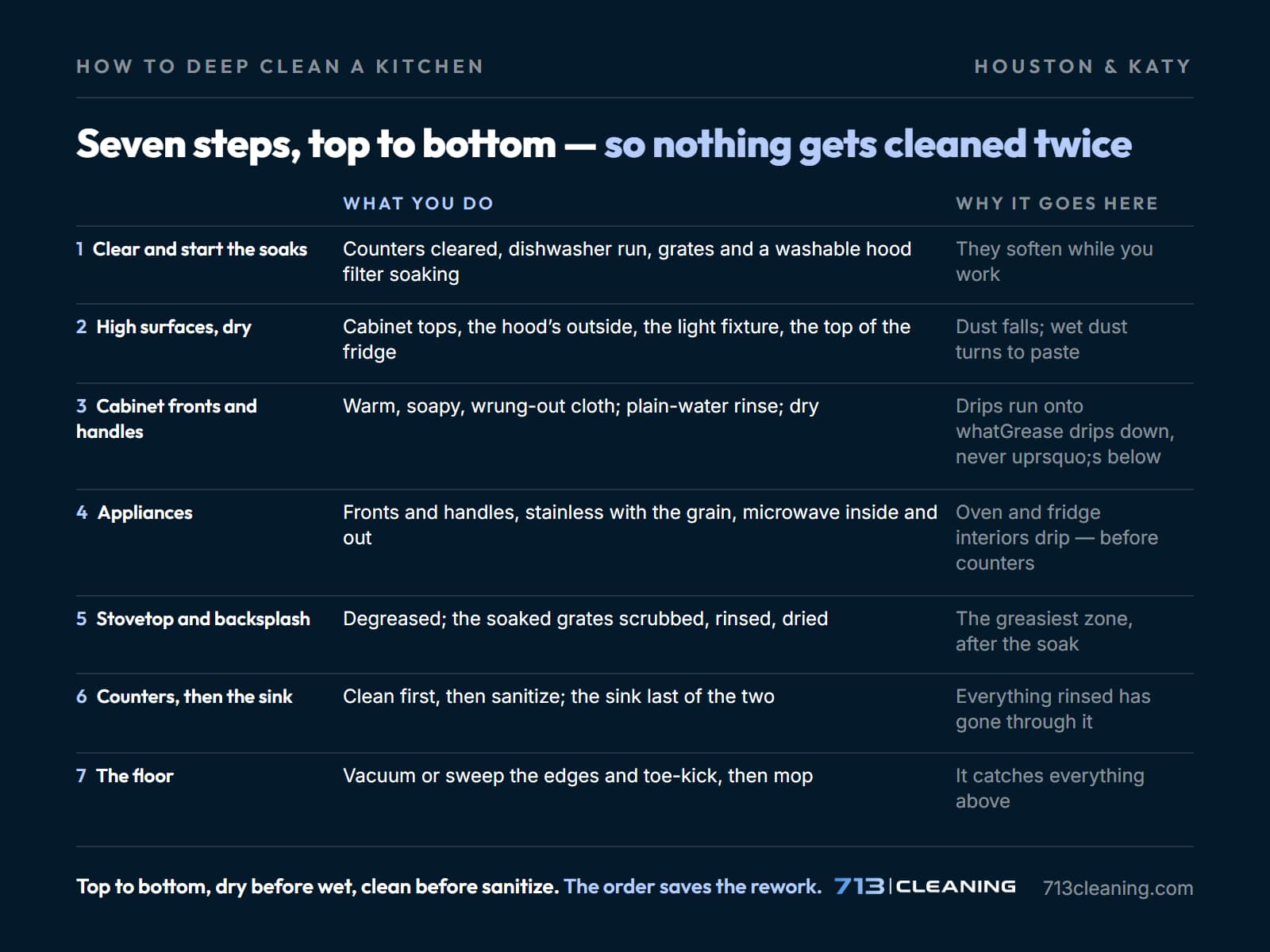
How to Deep Clean a Kitchen: The 7-Step Order
The order saves you rework; the right product for each surface saves the surface. Work against gravity and you clean things twice: dust from the cabinet tops lands on the counter you just wiped, and a floor mopped first collects everything above it. Three rules set the sequence — top to bottom, dry before wet, clean before sanitize — and our own published deep cleaning checklist works top-down too (“ceilings to baseboards”), though its list of inclusions is shorter than this DIY one.
1. Clear the counters and start the soaks
Everything that lives on the counter comes off it — the toaster, the knife block, the fruit bowl, the mail. Load and run the dishwasher so the sink is empty. Then start the things that need to sit: the stove grates in a bucket of hot, soapy water, and the range hood filter if it’s a washable metal one. Check your range’s manual first: some grates, cast iron especially, aren’t meant to soak, and every grate goes back on dry.
2. High surfaces first, dry
Cabinet tops, the outside of the range hood, the light over the island, the top of the refrigerator: dust them dry before anything gets wet, because wet dust turns to paste. Use a sturdy step stool, not a chair. If the tops of your upper cabinets feel tacky instead of dusty, that’s grease, and it gets the step-three treatment.
3. Cabinet fronts and handles
Cooking grease travels in the air before it settles, so it ends up as a film on the doors closest to the range and on every handle someone grabbed mid-recipe. In the homes we clean, those are the doors that need the most work; the ones across the room rarely do. A cloth wrung out in warm water with a few drops of dish soap, top to bottom; a second cloth with plain water; then dry. Nothing abrasive, and test anything stronger on the inside of a door first — the finish’s care instructions win. The full method, filter included, is in how to degrease kitchen cabinets and the range hood.
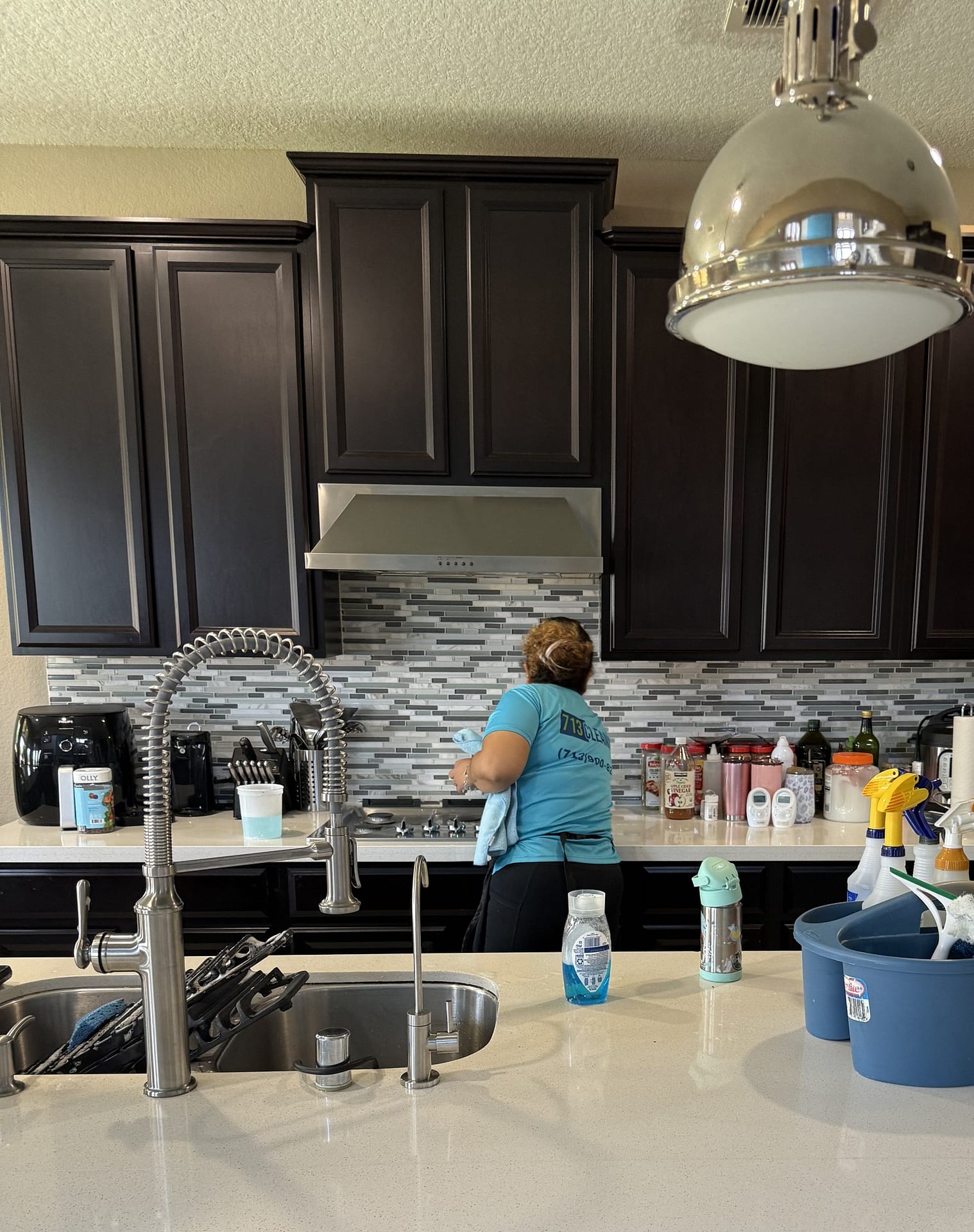
4. Appliances, outside — and inside, if you’re doing those too
The fronts and handles of the refrigerator, oven and dishwasher; stainless wiped with the grain using a product made for stainless; the microwave inside and out; the small appliances wiped and set aside until the counters are done. Stainless is the surface I’d be most careful with. One homeowner came to us after a private cleaner, by the homeowner’s account, permanently damaged a stainless appliance with the wrong chemical — one side of the story, but the lesson holds: read the appliance maker’s care instructions before anything stronger than soap and water touches it.
If you’re doing the inside of the oven and the fridge yourself, it goes here — before the counters and the floor, because both jobs drip. It’s also the step people most often hand off; how to clean inside the oven and fridge covers both, and when each one is worth booking instead.
5. Stovetop and backsplash
Burners off and cool. Degrease the cooktop and the backsplash behind it with the same warm, soapy cloth, and lift baked-on rings with a plastic scraper or a non-scratch pad — on a glass-ceramic top, use the cleaner its manufacturer recommends and nothing abrasive, and a natural-stone backsplash gets the same no-acid rule as stone counters. Now the grates come out of the soak: scrub, rinse, dry completely, and put them back.

6. Counters, then the sink
If you sanitize — food-prep surfaces are where it matters — clean first. The University of Maine Cooperative Extension’s kitchen guidance is to first clean, and then sanitize: soap and water take off the grime, and a sanitizer works on a surface that’s already clean. The CDC’s everyday version is to wash countertops with hot, soapy water after preparing each food item.
The extension guide also warns never to mix vinegar with hydrogen peroxide — together they make harmful fumes. Use a sanitizer that’s safe for your surface, mixed and left on the way its label says; vinegar, one of the extension’s homemade options, never goes on natural stone. That’s general food-safety guidance from both, and your counter’s maker decides the details for your surface.
The sink goes last, because everything you’ve rinsed has gone through it: the basin, the faucet and its handles, the strainer and the rim of the drain, cleaned first and sanitized if you’re sanitizing.
7. The floor, last
By now everything above has dropped crumbs and drips on it. Vacuum or sweep first — along the base of the cabinets, under the toe-kick, the gap beside the refrigerator as far as you can reach — then mop with as little water as the floor’s finish allows.
What to Use on Each Kitchen Surface
The order keeps you from redoing work; this keeps you from damaging something. When a surface’s own care instructions say something different, they win.
| Surface | Use | Avoid |
|---|---|---|
| Natural stone counters or backsplash | Mild dish soap and water, or a cleaner made for stone | Vinegar, lemon and other acids; abrasive powders |
| Stainless steel | Soap and water or a stainless product, wiped with the grain | Scouring pads; anything the maker’s care guide rules out |
| Glass-ceramic cooktop | The cleaner its manufacturer recommends | Abrasive powders and scouring pads |
| Cabinet finishes | A few drops of dish soap in warm water, cloth wrung out | Abrasives, untested stronger cleaners, standing water |
| Stove grates | Whatever the range manual says | Soaking cast iron the manual doesn’t clear; putting grates back wet |
| Food-prep counters | Hot, soapy water, then a surface-safe sanitizer per its label | Mixing products — vinegar and hydrogen peroxide included |
Where the Line Sits: What a Booked Deep Clean Covers in a Kitchen
Knowing how to deep clean a kitchen yourself doesn’t mean you have to — but a booked deep clean isn’t the same list as the seven steps. Some are included, two are add-ons, and some stay yours. Every crew row below comes from the published deep cleaning checklist.
| In the kitchen | Whose job |
|---|---|
| Counters and backsplash wiped and degreased; stovetop and range hood exterior cleaned and degreased; sinks cleaned and sanitized | The crew, on a deep clean |
| Every cabinet door, front and handle hand-wiped | The crew, on a deep clean (a regular visit spot-cleans fronts and handles) |
| Refrigerator, oven and dishwasher exteriors; stainless polished; microwave deep cleaned inside and out; small appliances, tables and chairs wiped | The crew, on a deep clean |
| Floors vacuumed and mopped, corners and baseboard edges detailed | The crew, on a deep clean |
| Inside the oven, inside the refrigerator | Add-ons, quoted separately — included in a move-in/move-out clean of an empty home |
| Inside the cabinets and drawers | Only in a move-in/move-out clean, when they’re empty — not part of a regular or deep clean |
| The range hood filter, the tops of tall cabinets | Yours — the hood’s outside is cleaned, the filter isn’t, and crews don’t climb higher than a two-step ladder |
| Hand-washing pots and dishes | Yours — the crew loads the dishwasher if it’s empty |
| Pulling the refrigerator or range out to clean behind it | Not part of any visit — our teams don’t move furniture or heavy appliances |
The biggest early mistake I see is not reading the checklist, and in a kitchen the classic version is dishes: we’ll load the dishwasher if it’s empty, but hand-washing pots isn’t part of the visit. For the rest of the house, what’s included in a deep cleaning walks the whole list room by room.
Houston and Katy Kitchens Specifically
Three local things change the plan here.
Hard water shows up at the sink. Every home here ages differently — neighborhood, water hardness, whether the softener is doing its job. In the homes we clean, a white crust at the base of the faucet and around the aerator is the kitchen’s version of the spotted shower door. Soap won’t move it; it’s a descaling job, so check the faucet’s finish first and keep acids off any natural stone around it.
The AC runs most of the year. Dust keeps arriving on the high, flat surfaces — the cabinet tops, the top of the refrigerator — and on top of a grease film it doesn’t dust off, it smears. That’s why step two is dry and step three is soapy.
The holidays land on the kitchen. A lot of families here moved to Houston for work, so the holidays mean relatives flying in, and the biggest deep-clean spike we see every year is the stretch before Thanksgiving and Christmas. If you’re hosting, plan the kitchen around it rather than the night before — book any add-ons with it — and use the guest-ready plan for the rest of the house.
What a Deep Clean Can’t Fix in a Kitchen
A clean removes what’s on a surface. It can’t reverse what happened to it, and a kitchen has more of that than any room in the house.
- Etched or scratched counters — acid marks on marble, knife marks on laminate — are damage. Cleaner, not new.
- Cabinet finish worn through next to the range or under the handles comes back clean, not refinished.
- Discolored or crazed oven enamel, and burned-in marks on a glass-ceramic cooktop, stay.
- Grime sealed between the panes of an oven door is a disassembly job, not a cleaning one.
- A smell from behind or under the refrigerator may mean moving it or a repair — and no visit moves appliances.
If one of those is the thing bothering you, it’s a repair or refinishing conversation, and an honest crew will say so.
What Good Looks Like Afterward
You’ll know the order worked when:
- The doors next to the range feel smooth, not tacky, when you run a finger down them.
- A metal hood filter lets light through when you hold it up — a rough check from range hood maker Broan-NuTone’s own guide.
- The grates sit flat and dry and the burner caps seat properly.
- No food residue in the sink, the strainer or around the drain rim, and the faucet base is clear.
- There’s no crumb line along the toe-kick.
If the film comes back on the cabinets fast, look at the hood filter before you look at your cleaning.
Keep Going
How to degrease kitchen cabinets is steps one and three in full, filter types included; cleaning inside the oven and fridge is the optional half of step four, with an honest answer on when to book it.
If you’d rather hand the kitchen off, our deep cleaning in Houston and Katy does the counters, the stovetop, every cabinet door and the appliance fronts by hand, and the oven and fridge interiors can be added to the quote. The hood filter and anything above a two-step ladder stay yours.
Frequently Asked Questions
How do you deep clean a kitchen step by step? Clear the counters and start the grates (if the manual allows) and a washable hood filter soaking; dust the high surfaces dry; degrease the cabinet fronts and handles; do the appliances; degrease the stovetop and backsplash; clean, then sanitize the counters and sink; and finish with the floor. Top to bottom, dry before wet.
How often should you deep clean a kitchen? In my experience, a home with a recurring cleaning in place needs a deep clean at least once a year, and more often without one or with heavy use. Some parts keep their own calendar: the hood filter on the schedule its maker gives, and the refrigerator on a regular cleaning rhythm of its own.
Should you clean or sanitize kitchen counters first? Clean first, then sanitize — that’s the extension guidance, because grime gets in a sanitizer’s way. Check your counter’s care instructions before any sanitizer, and keep vinegar off natural stone.
Does a professional deep clean include inside the oven and fridge? Not by default. On a regular or deep clean, inside the oven and inside the refrigerator are add-ons, quoted separately. In a move-in/move-out clean of an empty home, both are included.
Should I clear the counters before a cleaning crew comes? Yes — it’s the first thing I tell every new client. Put away the clutter and paperwork so the time goes into cleaning instead of organizing, and flag anything valuable in advance.